Monday, January 9, 2012

Why do some whole roast duck recipes slice the duck in half, and not others?

Question

Last time I made a roast, I used a recipe from BBC good food. Since I have had luck with those recipes, I decided to go for their roast duck recipe.

That recipe involves cutting the whole duck in half and roasting the halves with the skin pointing up. I have never roasted a bird like that before, and I am wondering why someone would do it. Does it have to do with the flavor of the meat? Proportion of fat? I don't think I'd ever do that to a chicken because I'd be afraid the meat would go dry. But obviously the flavor of duck is different, and maybe if I know why people do that, I can use it intelligently in my cooking.

Answer

The main reason why you want to cut the duck in half and roast them with the skin side pointing upwards is so the skin of the duck is nice and crispy. Unlike most roasted poultry where you don't eat the skin, the duck's skin is considered a huge delicacy if it is crispy.

How much could I safely heat a content-less cast-iron pan?

Question

To which temperature could I safely heat my cast-iron pan on the stove, without any contents? I don't want to re-season it afterwards. Afterwards, I'd just let the pan cool off in room temperature. The base is ~0.5 cm thick.

Answer

If it is completely empty, you probably can't reach dangerous temperatures with your stove. The iron itself melts at 1500°C. The seasoning can be burnt off at much lower temperatures, a self-cleaning cycle in the oven is enough for it (500°C). I have taken an iron pan to above 400°C without damaging the seasoning. (I don't know exactly how high it was, my thermometer doesn't go above 400°C). This was on an induction stove set at maximum, I doubt that any other kind of stove can produce such temperatures.

Edit I just heard an example showing that you can take a pan on a resistive stove to above 500°C with prolonged heating, so you should be measuring it if you plan to go that high. (and if you have a thermometer in this range, you can post your findings to further limit the range of 400° to 500°C, because I'm curious).

But if you say "no contents", be careful that it is actually just the pan. You cannot oil it, because the self-ignition temperature (of flash point) of vegetable oil is low, Wikipedia gives it at 327°C. It could just smoke terribly and throw a spark or two when you reach it, but it can also flame up and then you are holding a small brand in your hand.

What made these red lentils 'brick' together?

Question

enter image description here

The lentils in the above photo are raw. They did not form a solid block when they were dry, but after I poured a bit of water in, they suddenly did this.

Obviously, they need a bit of washing. Red lentils stick to the pan easily.

Answer

Red lentils have no skin and are thus more absorbent. They literally sucked up the wee bit of water clinging to them along with their neighbors. Surface tension of the water couldn't be broken by the light-weight pulses.

When crumbled apart, the brick doesn't feel pasty, no?

Next time maybe pour lentils into water; either way, no harm to finished dish.

Ratatouille Strudel

Question

We often have strudel for a vegetarian lunch option. Today's strudel was Ratatouille Strudel. What is strudel and what are the nutritional facts?

Answer

Strudel isn't a single dish, it is a family of dishes.

I think that the origin is actually from the Otoman empire, the Austrohungarians appropriated the dish when they shared a border (but don't have a source handy). It is still very popular on the Balkans. (Older fiction translations there don't say anything about "meat pies", they always talk of "meat strudels").

A strudel is defined by its dough. It is like laminated pastry without the laminating. The dough is made from a very simple recipe, often only just flour and water. It has no leavening at all. It is rolled out like pizza dough, but much longer, until the whole sheet is transparent (maybe 1/3 mm thick). You may hear that this is phylo dough, but in the West, I've only seen phylo sheets which were thicker than that, and they were dried.

The sheet is then filled with anything you want to have in it. In Germany, sweet kinds made with apple or cherries are most popular. On the Balkans, you have the sweet ones too, but it is more popular with pumpkin, almost never cherry. There are also savoury kinds there, especially with spinach or with a mixture of eggs and feta. But as you see with your Ratatouille, you can put practically any filling in it.

A thickish strip of filling is put on the sheet of dough, and it is rolled like a very large crepe (a sheet can reach 80 cm in diameter). The filled dough sheets can be laid in a rectangular pan parallel to each other, but it is more traditional to form a spiral from the first one and place it in the middle of a round pan, then add to the spiral with the second one, etc. Therefore the word "strudel", which means "maelstrom". It is baked, and it is cut along the radii of the spiral for serving.

enter image description here

I can't give you any nutritional information on strudel, because there isn't that much dough in it. The majority of calories will come from the filling, and I have no idea what was in yours. It won't be possible to define it even for the ratatouille itself, because there are lots of variations for that, too.

Sunday, January 8, 2012

What are the ways of classifying bread?

Question

What words and dimensions are used to describe bread and their recipes?

I realize describing bread is subjective, I'm only looking for common words to describe bread.

Answer

As for judging crumb, my favorite two terms used by German Meister Bakers are juicy (saftig) and woolly (wollig).

The first, praise for tarter breads such as sour rye; the second for toast bread and lunch rolls.

An unflattering term would be cotton (Baumwolle) for flavorless and dry fluff.

Is thick fruit skin safe to be eaten? [closed]

Question

There are kinds of fruit where it's common for people to eat the fruit together with the skin (apple, grapes etc.). But there are some where people would peel off the skin beforehand like the kind of orange, banana, water melon etc. The skin does contain a heavy dose of fiber, and am wondering is it safe, or even healthy, to eat the skin?

But has anyone eat fruits such as orange or banana wholly without peeling off the skin, and find any health issue (positive or negative)? Assuming the skin is washed clean, do people peel skin because just it taste bitter?

Answer

this depends very much on:

  • the specific kind of fruit you're about to eat;
  • Cultural normatives;
  • your personal flavor and preference;

For instance: I eat Avocados with the skin. Seriously. I do. Some of my friends consider it to be weird, but i couldn't care less - when they are ripe i just slice them as they are, stack 'em on a piece of bread and feast away with a sprinkle of salt.

Most fruits i know of have edible skins - even citrus skin, as sour and zesty as it may be, is edible - and is used for producing all sorts of sweets, flavor extract and even food for animals.

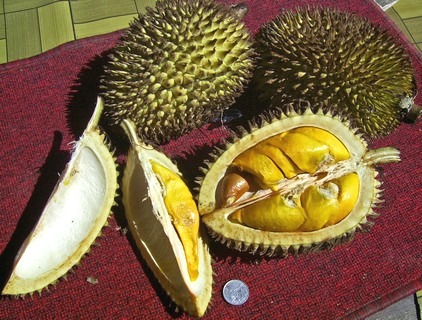
I wouldn't go ahead and eat the skin of the Durian fruit - it's probably 'edible' but.... i donno.... it just doesn't feel right (plus the smell of it is UNBEARABLE)

Grilling duck - How can I get the fat?

Question

I'm going to grill a whole duck tomorrow. I am going to steam the duck before so the fat will render off. When that's complete, I am going to have a pot full of duck fat and leftover water.

What's the best way to get the fat off? Refrigerate the water till the fat separates? Boil the pot until the water evaporates?

Answer

Refrigerate it and the fat will get on top of the water.